
Nursery

Welcome to Beam's Nursery

Our teacher is Mrs Bower

EYFS Support Staff: Mrs Roomes, Ms O'Leary

Phase Group Leader:  Mrs Taylor

We want every child to feel happy, safe, valued and excited to come to Nursery. Our Nursery provides a balance of child-initiated play, adult-guided learning, stories, songs, practical experiences, outdoor learning and opportunities to develop independence.

We recognise that every child is unique and develops at their own pace. We work closely with families to help children build the communication, physical, social and emotional foundations they need to become confident, curious and enthusiastic learners.


Our Approach to Learning

Children in Nursery learn through a carefully planned balance of play, exploration and purposeful adult interaction. We provide opportunities for children to follow their interests while also introducing new experiences, vocabulary, skills and knowledge.

We value the importance of talk, relationships, movement, independence and hands-on experiences. Children are encouraged to have a go, make choices, solve problems, persevere and learn from their experiences.

Our curriculum follows the seven areas of learning in the Early Years Foundation Stage and is carefully sequenced across the year.  We are delighted to note that Ofsted recognised this and graded the nursery as Outstanding. 
 

Communication and language are at the heart of everything children learn in Nursery. Developing vocabulary, listening carefully and being able to express ideas and feelings are important foundations for learning, friendships and future reading and writing.

In Nursery, we develop communication skills through:

  • conversations with adults and other children
  • sharing stories, poems and nursery rhymes
  • introducing and modelling new vocabulary
  • singing and music
  • role play and imaginative play
  • small-group activities
  • encouraging children to explain their ideas and experiences
  • listening and responding to others
How can I help my child at home?

Talk to your child about what you are doing together.
Introduce new words and explain what they mean.
Ask questions and give your child plenty of time to answer.
Encourage your child to describe what they can see, hear, feel and notice.
Share books every day and talk about pictures, characters and events.
Sing nursery rhymes and songs together.
Encourage back-and-forth conversations rather than asking lots of questions.
Model sentences and new vocabulary rather than simply correcting mistakes.
Every conversation is an opportunity to learn!

In Nursery, we use Little Wandle Foundations for Phonics to develop the early listening, language and phonological awareness skills that support later reading.

Our focus is on:

·       listening and attention

·       hearing and playing with sounds

·       enjoying nursery rhymes, rhythm and repetition

·       developing vocabulary and speaking skills

·       hearing sounds in words

·       joining in with familiar rhymes and repeated phrases

·       building confidence in speaking and listening.

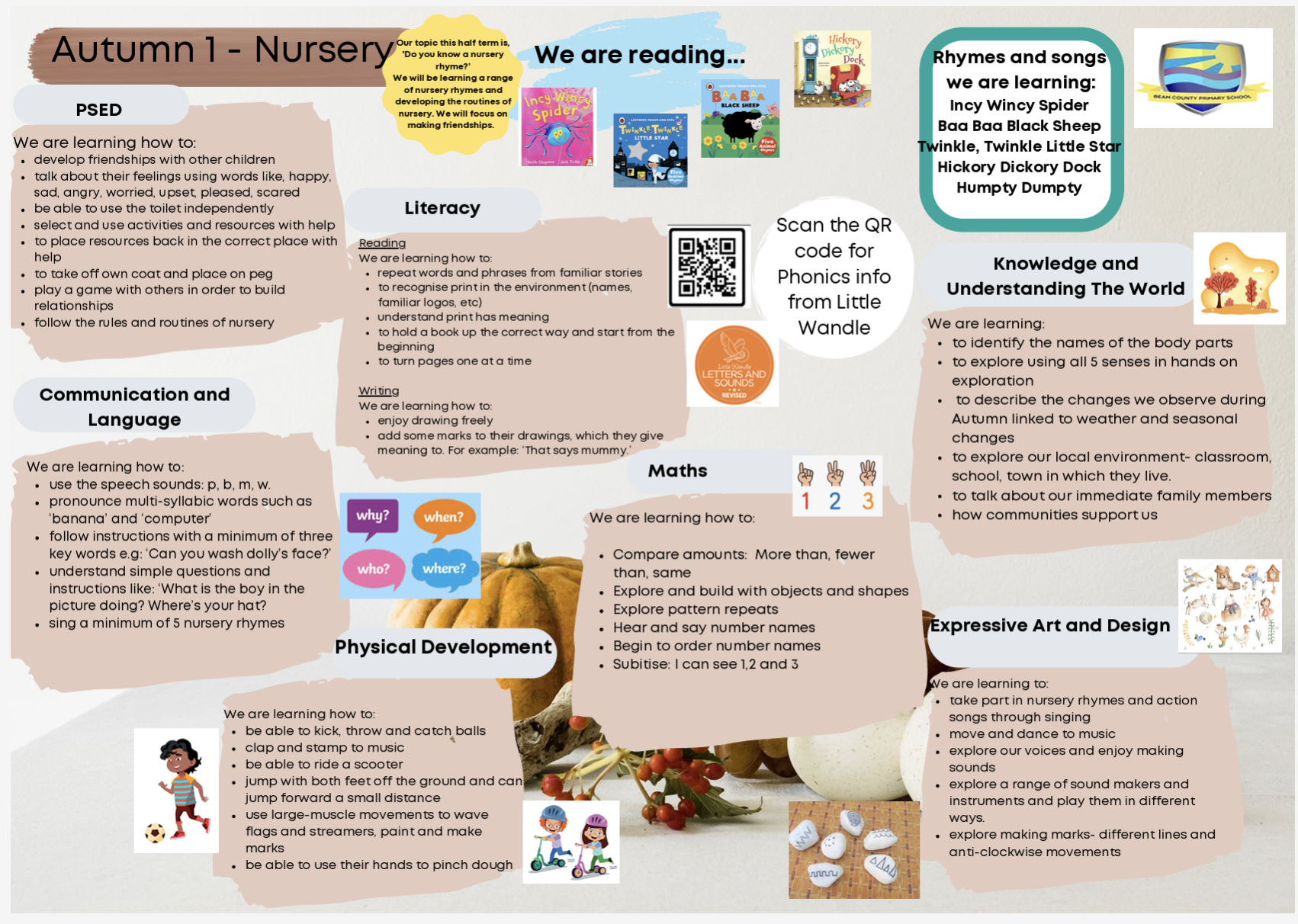
Our Autumn 1 curriculum map includes learning speech sounds such as p, b, m, and w; developing pronunciation of longer words; following instructions with at least three key words; understanding simple questions; and singing at least five nursery rhymes. These are part of the broader foundations for phonics and communication work.

How can I support my child at home?
  • Sing familiar nursery rhymes together.
  • Encourage your child to join in with repeated words and phrases.
  • Make up silly rhymes together.
  • Clap syllables in names and words.
  • Play listening games and talk about the sounds you can hear around you.
  • Share lots of stories and talk about the pictures and characters.
Try these resources:

Little Wandle Foundations – resources for families: Little Wandle Foundations

Nursery rhyme resources for parents: Little Wandle – Nursery Rhymes

[Suggested webpage button: “Nursery Rhymes to Enjoy at Home”]

We want every child to develop a lifelong love of books and reading. In Nursery, books are an important part of our day and are used to support children's language, communication, imagination and understanding of the world.

Each term, we select focus books linked to our current topic. Alongside these, we share a wide range of other stories throughout the year. We read stories twice each day, with a particular focus on books with rhyme, rhythm, and repetition.

Autumn 1 – Do You Know a Nursery Rhyme?

Our Autumn 1 topic is “Do You Know a Nursery Rhyme?”. We are learning a range of traditional nursery rhymes while helping children settle into Nursery life, develop friendships and learn our routines.

Our rhyme-linked focus books include:

  • Incy Wincy Spider
  • Twinkle, Twinkle Little Star
  • Baa Baa Black Sheep
  • Hickory Dickory Dock

Our rhyme and song repertoire also includes Humpty Dumpty. The full Autumn 1 curriculum map includes further information about what children are learning across the seven areas of learning.

[Suggested webpage feature: “This Half Term We Are Reading…” with the focus-book images from the Autumn 1 curriculum map.]


After the October half-term holiday, children will begin visiting our school library each week.

  • Children attending all-day or afternoon Nursery will visit the library on Tuesdays.
  • Children attending morning Nursery will visit the library on Fridays.

Each week, your child will have the opportunity to choose a book from the library to take home for you to share together.

Important: The library book your child brings home is for you to read to your child – they are not expected to read it themselves.

At this stage, we want children to develop a love of stories and books, listen to rich language and enjoy talking about what they have heard. Please make time to sit together, look at the pictures, talk about what is happening, ask questions and enjoy the story.

Children often benefit from hearing favourite stories repeatedly. Encourage your child to join in with familiar words, phrases and rhymes.

Please bring a suitable book bag. Your child will need a bag that is large enough to safely carry a library book to and from school. A book bag is ideal and will also help your child become familiar with the routine they will have in Reception.

In Nursery, we develop children's mathematical understanding through practical, hands-on experiences, play, songs, stories and everyday activities. We encourage children to develop confidence with numbers, shapes, patterns, space, measures and mathematical language.

Autumn 1
  • Compare groups of objects, beginning to understand more, fewer and the same.
  • Explore and build with different shapes and objects.
  • Explore simple repeating patterns.
  • Hear and use number names in everyday activities.
Autumn 2
  • Begin to say number names in the correct order.
  • Recognise small quantities of 1, 2 and 3 without always needing to count.
  • Join in with and continue simple repeating patterns.
  • Explore position and space, using words to describe where objects are.
Spring 1
  • Recognise and show quantities of 1, 2 and 3.
  • Count and use number names for objects and actions involving 1, 2 and 3.
  • Explore position, movement and simple routes.
  • Explore and talk about different patterns.
Spring 2
  • Develop an understanding of 1, 2 and 3 through practical activities, including giving and taking objects.
  • Match, sort and explore objects through hands-on activities.
  • Recognise and talk about quantities represented by dots and other arrangements.
  • Compare and sort collections of objects, noticing similarities and differences.
Summer 1
  • Create and lead simple repeating patterns.
  • Explore shapes and develop problem-solving skills through puzzles and construction.
  • Make patterns together using objects, movements and actions.
  • Use mathematical ideas to create and play simple games.
Summer 2
  • Create, copy and talk about their own repeating patterns.
  • Recognise and show quantities up to 5.
  • Count confidently to 5.
  • Match, sort and compare objects and quantities.
Supporting Maths at Home

Try counting everyday objects, looking for numbers in the environment, spotting shapes, making patterns, comparing quantities and talking about size and position. The most important thing is to keep maths practical, playful and fun!


Maths Rapid Recall Homework

A1 - I can say the numbers from 0 to 5 and back from 5 to 0 in order 
 
A2 - I can say the numbers from 0 to 10 and back from 10 to 0 in order 
 
Sp 1- I can partition numbers, to 5, into two groups 
 
Sp2 - I can say which number is one more or one less than a given number to 20 
 
Su 1- I can count, read and write numbers to 20 
 
Su 2 - I can say the numbers from 0 to 20 and back from 20 to 0 in order 

In Nursery, we spend lots of time helping children to become increasingly independent. Skills such as putting on a coat, using cutlery, opening containers and managing clothing are important foundations for children's confidence, physical development and readiness for school.

We also develop fine motor skills – the small movements of the hands and fingers that support later skills such as handwriting, using scissors and manipulating classroom equipment.

Children develop these skills through:
  • playdough and modelling
  • threading and weaving
  • puzzles and construction
  • drawing, painting and mark-making
  • using scissors
  • tweezers and other small tools
  • dressing dolls and role play
  • cooking and food preparation
  • gardening
  • using cutlery
  • fastening coats, shoes and clothing
How can I help at home?
  • Encourage your child to put on and take off their own coat.
  • Practise fastening zips and buttons.
  • Encourage your child to put on their own shoes and wellies.
  • Let them practise using a knife, fork and spoon.
  • Encourage them to open their own lunchbox and food packaging.
  • Let them pour their own drink where appropriate.
  • Involve them in cooking and baking.
  • Provide opportunities for playdough, Lego, puzzles, threading, drawing and painting.
  • Give your child small household or gardening jobs that they can manage.

Allowing children time to have a go, make mistakes and persevere helps to build independence, confidence and resilience.

Outdoor learning is an important part of our Nursery experience. Children have regular opportunities to explore, investigate, move, play and learn outdoors.

Our Forest School sessions will begin during the Spring term. We will notify parents of the day or days for their child's Forest School sessions closer to the time, and we will update the website with this information.

Why Forest School?

Forest School provides opportunities for children to explore the natural world, develop confidence and independence, solve problems, take appropriate risks and build resilience. It also supports physical development, communication and social skills through practical, child-led exploration.

What should my child wear
  • We will provide waterproof trousers.
  • We will provide a waterproof jacket.
  • We will also provide gloves.
  • Parents should keep a pair of wellington boots in school for their child.
  • Children should be dressed appropriately for the outdoor temperature.  Our waterproof jackets are rain jackets, not padded winter coats, so they do not provide warmth. Please ensure your child has suitable warm layers underneath their waterproof clothing during colder weather.
  • Trousers are recommended for Forest School. Skirts and dresses can be uncomfortable when waterproof trousers are worn over the top and can make it more difficult for children to move freely.

Starting Nursery is a big step for children. We help children build secure relationships, confidence and independence while learning how to manage feelings, make friends and follow the routines of Nursery.

In Autumn 1, our curriculum specifically focuses on developing friendships, talking about feelings, using the toilet independently, selecting and returning resources, taking off a coat and placing it on a peg, playing games with others and following Nursery rules and routines.

We want children to feel proud of what they can do and confident to ask for help when they need it.

Being ready for Reception is about much more than knowing letters and numbers. We want children to leave Nursery feeling confident, independent, curious and excited about learning.

We support children to develop skills such as:

  • communicating their needs and ideas
  • listening and following simple instructions
  • managing their belongings
  • putting on and taking off their coat
  • using the toilet as independently as possible
  • eating and drinking as independently as possible
  • forming friendships and playing cooperatively
  • talking about and managing feelings
  • persevering when something is difficult
  • enjoying books, stories and nursery rhymes
  • being curious and ready to explore.

Our Nursery expectation is that children joining Nursery are out of nappies and using the toilet, unless they have SEND or a diagnosed medical condition affecting their bowel or bladder.

We understand that being out of nappies does not necessarily mean that your child is completely independent with toileting. Children may still need reminders, encouragement and support, and accidents can be a normal part of developing independence.

At Nursery, we will support children as they continue to develop their toileting skills. We encourage children to recognise when they need to use the toilet, communicate their needs, manage their clothing, use the toilet appropriately and wash and dry their hands.

Please provide at least two complete sets of spare clothes in a clearly labelled bag each day. This allows us to support your child calmly and quickly if an accident occurs.

If your child has SEND or a diagnosed bowel or bladder condition, please speak to us before they start Nursery so that we can discuss their individual needs and agree how we can best support them.

Helpful resource: ERIC – Potty Training

Additional resource: ERIC – Toilets and School Readiness

Every child develops at their own pace, and there is a wide range of development that can be typical for young children. If you have questions or concerns about your child's development, please talk to us.

We know your child well and can share what we see in Nursery, discuss any concerns with you and work together to decide what support might be helpful. Where appropriate, we may suggest speaking to other professionals who can offer additional advice or support.

Development Matters is the Department for Education's non-statutory guidance for the Early Years Foundation Stage. It provides a broad overview of how children develop and learn and is intended to guide professional judgement rather than act as a checklist.

View Development Matters on GOV.UK

The DfE states that Development Matters is not designed to be used as a tick list and that children's development is not a fixed or orderly process.

The beginning and end of the Nursery day are wonderful opportunities to connect with your child and develop their communication and language skills.

We kindly ask parents and carers to put phones away during drop-off and pick-up wherever possible. Even a few minutes of uninterrupted conversation can make a difference to your child's language development and emotional wellbeing.

  • Ask your child about their day.
  • Talk about what they can see around them.
  • Listen to them tell you about something they have done.
  • Introduce new vocabulary.
  • Sing a nursery rhyme together.
  • Simply chat and enjoy some special time together.

Your child is never too young for a conversation!

You do not need to sit down and formally 'teach' your Nursery child at home. Everyday experiences provide wonderful opportunities for learning.

  • Read and share stories every day.
  • Sing nursery rhymes and songs together.
  • Talk to your child and introduce new vocabulary.
  • Count everyday objects, steps, toys or food.
  • Spot numbers and shapes when you are out and about.
  • Make and copy simple patterns.
  • Encourage your child to dress, feed and tidy up as independently as possible.
  • Give your child time to practise physical and fine motor skills through play.
  • Talk about feelings, friendships and what happens during the day.

The most valuable things you can give your child are time, conversation, stories, play and opportunities to have a go.

Our Nursery uniform is designed to be practical and comfortable for children who spend their day learning, playing and exploring.
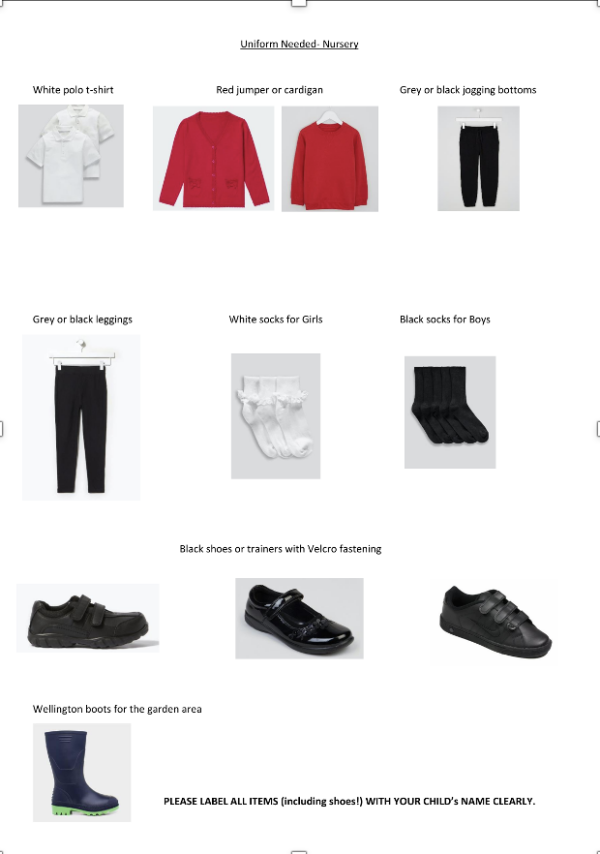
Uniform requirements
  • White polo T-shirt
  • Red jumper or cardigan
  • Grey or black jogging bottoms
  • Grey or black leggings
  • White socks for girls
  • Black socks for boys
  • Black shoes or trainers with Velcro fastening
  • Wellington boots for the garden area

Please label ALL items, including shoes, clearly with your child's name.

As a Healthy School, we encourage children and families to make healthy choices about food. A nutritious, balanced lunch helps children to have the energy they need to learn and play throughout the afternoon.

Children do not need to bring a snack to school. The only food you should send to school is your child's lunch, packed in a lunchbox.

Please remember
  • No fish, due to allergies within the school.
  • No chocolate.
  • No nuts - we are a nut-free school due to allergens
  • No fizzy drinks.
  • Please do not over-pack your child's lunch.

If we feel that your child does not have an adequate lunch option, we will offer them a school dinner. If you have concerns regarding your child's eating at school, please speak to your child's class teacher.

A balanced lunch should include:
   
Food group
Examples
Carbohydrate / starchy food Bread, roll, wrap, pitta, crackers, pasta or rice
Protein source Ham, chicken, turkey, beef, sausages, cheese, pâté, boiled egg or yoghurt
Fruit/vegetable Whole fruit, sliced vegetables, chopped fruit/vegetables or dried fruit
Other options Flapjacks, malt loaf, rice cakes, jelly or fruit pouches
We believe these pictures showcase some of the incredible learning experiences taking place at our wonderful Nursery.
Early Education Provision

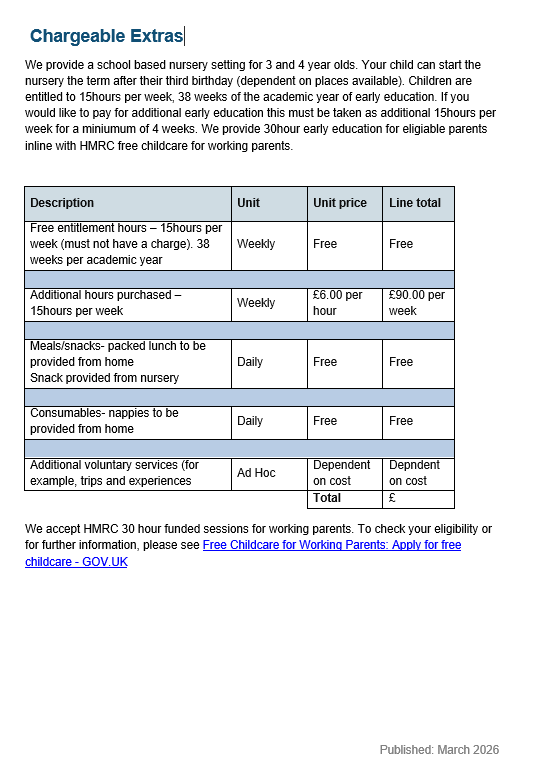
We offer funded early education places in line with government guidelines.  Eligible children can access up to 15 or 30 hours of free early education per week, depending on family circumstances.  These funded hours are delivered during time term and cover high quality teaching, learning activities and care.
 

Community

Inspiration

Striving